

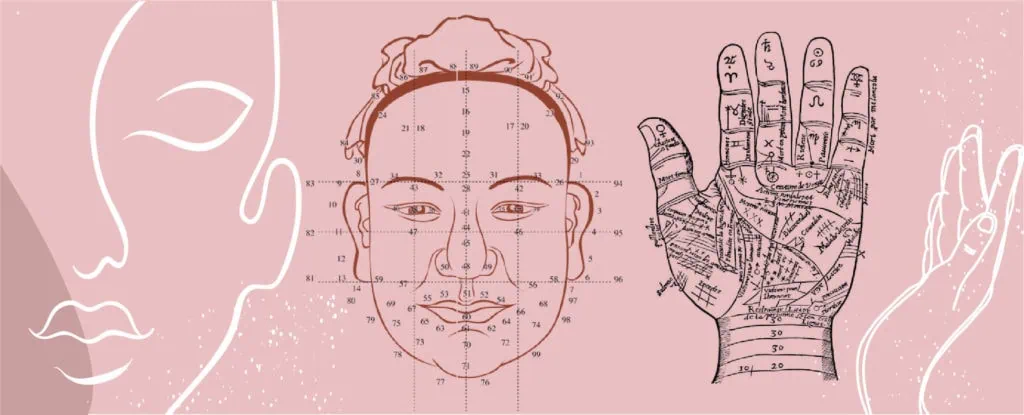
Human beings have always been fascinated by the idea that our physical features carry hidden meanings. Just as lines on the palm are thought to reveal aspects of fate, personality, and potential, the features of the face have long been studied as maps of the soul. This practice, often called face palmistry, suggests that every curve, line, and proportion on your face may reveal something about who you are and what life holds for you.
This guide explores the history, principles, and methods behind this ancient art, offering you a clear picture of how people across cultures have interpreted the human face for centuries.
What Is Face Palmistry?
At its core, face palmistry is the practice of interpreting facial features to gain insights into a person’s character, emotions, and destiny. Unlike palmistry, which focuses on the hands, this tradition looks at the face as a living map.
Cultures in China and India developed face-reading systems thousands of years ago. For example, the Chinese art of Mian Xiang categorizes the face into zones connected with health, fortune, and personality. Similarly, Indian Samudrik Shastra examines the shape of the forehead, nose, and eyes to evaluate a person’s future.
The belief is that the face reflects inner traits outwardly. From the curve of your eyebrows to the width of your jaw, each detail is thought to carry meaning.
The Origins and History of Face Palmistry
The roots of this practice are deep and diverse:
- China: Mian Xiang dates back over 3,000 years and remains a cornerstone of Chinese metaphysics. It was once used to choose leaders, assess marriage compatibility, and guide health practices.
- India: Samudrik Shastra is a broader science that includes reading the whole body, but the face holds a central role. Ancient texts describe how forehead lines or eye shapes hint at fortune and karma.
- Western Adaptations: In the Renaissance, European scholars merged physiognomy with astrology and medicine, treating the face as a diagnostic and mystical tool.
The survival of face palmistry across cultures shows its appeal: the face is the most expressive and personal part of the body, making it natural for humans to look there for meaning.
The Principles of Face Palmistry
Face reading is not random observation. Practitioners often follow structured principles:
- Facial Zones: The forehead, eyes, nose, mouth, and chin each represent different aspects of life.
- Life Map: Some traditions divide the face into zones tied to different stages of life, from youth to old age.
- Symmetry and Balance: A balanced face is often seen as a sign of harmony, while asymmetry may suggest inner conflict.
- Energy Flow: In Eastern systems, the face is seen as a reflection of yin and yang energy.
For example, someone with a broad forehead might be described as intellectual and visionary, while a strong jaw suggests persistence.
Facial Features and Their Meanings in Face Palmistry
The Forehead
The forehead is linked with intellect, memory, and the early years of life.
- Broad, high forehead: Analytical, good at planning, often intellectual.
- Narrow forehead: Practical, detail-oriented, less interested in abstract thinking.
- Wrinkles or lines: Experience, wisdom, sometimes worry.
The Eyes
Often called the “windows of the soul,” the eyes are central in face reading.
- Large eyes: Warmth, openness, curiosity.
- Small eyes: Focused, careful, disciplined.
- Wide-set eyes: Flexibility, creativity.
- Close-set eyes: Concentration, seriousness.
The Nose
The nose is tied to wealth, ambition, and leadership.
- Straight nose with a strong bridge: Confidence and success.
- Rounded nose tip: Generosity and compassion.
- Wide nostrils: Strong drive, appetite for life.
The Mouth and Lips
Communication and relationships are revealed here.
- Full lips: Expressive, affectionate, sociable.
- Thin lips: Reserved, focused, practical.
- Downturned corners: Pessimism or seriousness.
The Chin and Jawline
This region is tied to willpower, determination, and later life.
- Strong, square chin: Persistence, strength, resilience.
- Pointed chin: Sensitivity, artistic inclinations.
- Receding chin: Tendency to avoid confrontation, may struggle with assertiveness.
The Three Zones of the Face in Palmistry
Face palmistry often divides the face into three vertical zones, each linked to a stage of life:
| Zone | Area Covered | Represents |
| Upper Zone | Forehead | Intellect, early years, parental influence |
| Middle Zone | Eyes, nose, cheeks | Emotions, career, middle life |
| Lower Zone | Mouth, chin, jawline | Willpower, later years, legacy |
For example, a person with a well-developed lower zone is thought to have strong determination and a fulfilling later life, while a prominent upper zone suggests a rich intellectual youth.
Common Face Shapes in Face Palmistry and Their Interpretations
Round Face
- Traits: Sociable, warm, compassionate.
- Weakness: May struggle with boundaries or self-discipline.
Square Face
- Traits: Strong-willed, practical, hardworking.
- Weakness: Stubborn, resistant to change.
Oval Face
- Traits: Balanced, diplomatic, adaptable.
- Weakness: May avoid conflict and decision-making.
Long Face
- Traits: Ambitious, enduring, patient.
- Weakness: Can become overworked or isolated.
How to Practice Face Palmistry Yourself
If you want to try this practice, here’s a beginner’s approach:
- Start with Observation: Look at overall face shape first, then focus on zones and individual features.
- Note Symmetry: Symmetry often reflects balance in character.
- Check Expressions: Static features are important, but expressions reveal habits.
- Use a Mirror: Start with your own face to see how meanings apply.
- Avoid Over-Generalization: Not every trait should be taken literally. Context matters.
Common Mistakes to Avoid
- Overemphasizing one feature.
- Ignoring the role of expression and environment.
- Forgetting cultural differences in interpretations.
Face Palmistry in Modern Life
Today, face palmistry is often combined with psychology, body language, and even career counseling. It’s seen less as a fortune-telling tool and more as a method of self-reflection.
- Counseling: Some coaches use face reading to better understand clients.
- Business: Leaders sometimes study facial cues to improve negotiations.
- Social Media: Short videos on face reading attract millions of views, showing its modern popularity.
Face Palmistry vs Palm Reading: Key Differences
| Aspect | Face Reading | Palm Reading |
| Area Studied | Facial features and zones | Hand lines and mounts |
| Life Stages | Mapped onto facial regions | Time zones across palm lines |
| Focus | Personality, health, destiny | Fate, emotions, life path |
| Combination | Offers external expression clues | Reveals subconscious tendencies |
Practitioners often use both together, creating a fuller picture of a person.
Myths and Misconceptions About Face Palmistry
Like many ancient practices, face palmistry faces criticism and myths:
- Myth 1: It’s purely superstition.
- Fact: While not scientifically proven, many insights overlap with modern psychology.
- Myth 2: Features determine fate with certainty.
- Fact: They suggest tendencies, not fixed outcomes.
- Myth 3: Only experts can read faces.
- Fact: Anyone can learn the basics with practice and observation.
Ethical readers stress that interpretations should empower, not scare, people.
Case Studies and Famous Examples
- Abraham Lincoln: His prominent cheekbones and deep-set eyes were often described as signs of determination and wisdom.
- Marilyn Monroe: Her full lips and rounded facial shape matched her reputation for charm and warmth.
- Elon Musk: His strong jawline and pronounced chin often align with traits of resilience and ambition in face palmistry.
These examples show how traits linked to features sometimes align with public perception.
Should You Trust Face Palmistry?
This practice should be approached with an open yet critical mindset. On one hand, it can offer valuable insights for self-reflection, helping you recognize strengths and weaknesses. On the other, it’s not a science and shouldn’t be treated as destiny.
Use it as a tool for curiosity, much like body language analysis or personality tests. When practiced thoughtfully, it can encourage empathy and deeper understanding of yourself and others.
Conclusion
Face palmistry remains a captivating blend of tradition, symbolism, and psychology. From ancient Chinese scholars to modern-day enthusiasts, people have looked at the human face as a mirror of the soul. Whether you see it as cultural wisdom, a self-discovery tool, or simply a fascinating curiosity, studying the face can provide new perspectives on the people around you.
The key is balance: treat it with respect but also with a critical mind. The face does tell a story, but you’re still the author of your own life.












Leave a Reply