

eWhen you ask “how long is a city block”, you’re diving into a surprisingly complex topic. Most people assume that city blocks are all the same length, but in reality, block size varies widely depending on the city, country, and even the neighborhood. Understanding the average size of a city block matters because it directly affects walking distances, driving routes, navigation apps, and even real estate value. This guide explores the dimensions of city blocks in the U.S. and abroad, explains why block sizes differ, and shows you how to estimate distances in everyday life.
Introduction to City Blocks
A city block is the basic unit of urban space. Think of it as the land surrounded by four streets, forming a rectangle or square. Blocks are the building units of cities, shaping neighborhoods and influencing how people move. When someone asks “how long is a city block”, they usually want to know either walking distance or actual measurements in feet and meters.
City blocks are more than just a way to measure distance. They influence the character of a city. For instance:
- Shorter blocks mean more street corners, easier walking, and more pedestrian activity.
- Longer blocks favor cars, create fewer intersections, and often stretch distances for walkers.
Average Length of a City Block
General Estimates in the United States
There isn’t a single universal block size, but many American cities follow rough standards. A typical U.S. city block measures about 300 to 325 feet (91 to 99 meters) on one side. However, in grid-based cities like Chicago, blocks can reach 660 feet (201 meters).
For comparison:
- New York City (Manhattan): A block between avenues is about 750 feet, while blocks between streets are roughly 250 feet.
- Chicago: Uses an 8-blocks-per-mile system, making each block 660 feet long.
- Los Angeles: Varies significantly, with larger suburban-style blocks stretching 600–700 feet or more.
Metric Conversions
To make things simple, here’s a quick conversion chart:
| Measurement | Feet | Meters |
| Small block (NYC street) | 250 ft | ~76 m |
| Average U.S. block | 300–325 ft | ~91–99 m |
| Large block (Chicago, LA) | 660 ft | ~201 m |
| Long Manhattan block (avenue) | 750 ft | ~229 m |
How City Blocks Differ Around the World
City Block Length in North America
In North America, blocks tend to be longer and follow planned grids. For instance, Salt Lake City famously has massive blocks, measuring 660 by 660 feet, which makes crossing the city on foot more demanding. In contrast, Portland, Oregon, has much shorter blocks at only 200 feet each, making it one of the most pedestrian-friendly U.S. cities.
City Block Size in Europe
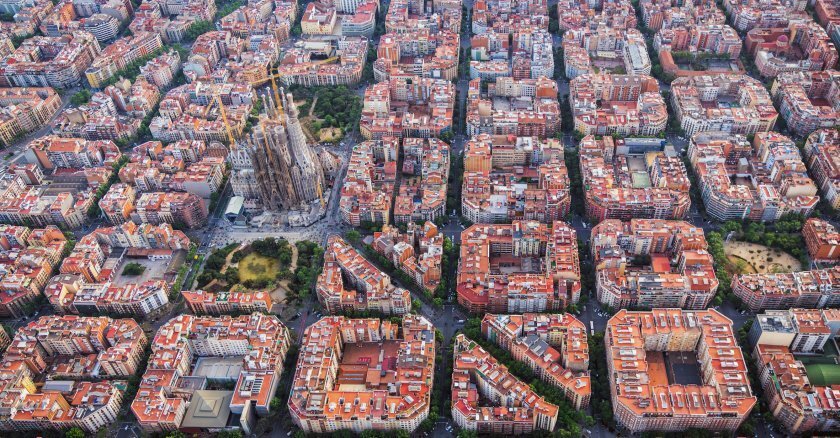
Europe tells a different story. Many European cities grew organically, so block sizes vary wildly. In Paris, medieval quarters have narrow, irregular blocks, while newer boulevards have more spacious layouts. Barcelona’s Eixample district is famous for its octagonal blocks, each about 400 by 400 feet (122 by 122 meters).
City Block Measurements in Asia and Latin America
Asian and Latin American cities show even more diversity:
- Tokyo: Streets often lack an orderly block grid, so “blocks” are less useful for navigation. Distances are usually measured by time instead.
- Mexico City: Colonial planning created medium-sized rectangular blocks, around 100 meters per side.
- Beijing: Features enormous “superblocks” that can stretch over 500 meters between major streets.
Why City Blocks Aren’t Standardized
City blocks vary because urban design reflects history, geography, and local priorities.
- Historical growth: Medieval towns developed without formal planning, leading to irregular blocks.
- Grid systems: Enlightenment-era planning in the Americas pushed for orderly grids, creating uniform blocks.
- Zoning laws: Different uses—residential, commercial, industrial—demand different block lengths.
- Geography: Rivers, hills, and coastlines disrupt neat grids, producing unusual block shapes.
As urban planning historian Lewis Mumford once noted, “The shape of a city is the shape of civilization itself.” Block size is one of those subtle choices that makes cities unique.
How to Estimate Walking Distance by Blocks
When you’re walking through a city, it’s natural to wonder how many blocks equal a mile or how long it’ll take to reach your destination.
Average Walking Time per City Block
On average, a person walking at a normal pace covers one block in about 1–2 minutes. This depends on the block size:
- Short block (200 ft): 1 minute
- Average block (300–325 ft): 1.5 minutes
- Long block (660 ft): 2–2.5 minutes
Step Count for One Block
For health-conscious walkers tracking steps:
- One block typically equals 100 to 200 steps, depending on your stride length and the block size.
Practical Examples
Here’s a useful reference table:
| Distance | Approximate Blocks | Time Walking |
| 1 mile (1.6 km) | 12–20 blocks | 15–20 minutes |
| ½ mile (0.8 km) | 6–10 blocks | 7–10 minutes |
| 10 minutes walking | 6–8 blocks | ~0.5 mile |
So if you’re in Chicago, where blocks are long, it takes 8 blocks to cover one mile. In Portland, it’s closer to 20 blocks per mile.
Case Studies of Famous Cities
Manhattan’s Grid System
New York City’s grid is world-famous. Streets run east-west, and avenues run north-south. The dimensions:
- Street-to-street blocks: ~250 feet (shorter)
- Avenue-to-avenue blocks: ~750 feet (longer)
This explains why walking “across” Manhattan feels shorter than walking “uptown.” In fact, 20 street blocks equal one mile, but only 5–6 avenue blocks equal a mile.
Chicago City Blocks
Chicago offers a textbook example of urban planning. Its grid was designed so that 8 blocks equal one mile, making it easy to calculate distances. For example, if you walk from 800 North to 1600 North, you’ve covered one mile. This consistent system makes navigation remarkably intuitive.
Other Notable Examples
- Portland, Oregon: Very short blocks at 200 feet, leading to 20 blocks per mile.
- Salt Lake City: Enormous blocks at 660 feet, with only 8 per mile, which some residents say makes the city less walkable.
Why Block Length Still Matters Today
City blocks may sound like an old-fashioned measure, but they remain essential. Apps like Google Maps often list walking times, but locals still speak in terms of blocks. Real estate listings highlight “just three blocks from downtown,” and urban planners debate block length when designing pedestrian-friendly spaces.
Shorter blocks:
- Encourage walking
- Increase business exposure
- Create more social interaction
Longer blocks:
- Reduce traffic congestion
- Allow larger lots and parking space
- Work better for car-centric suburbs
Conclusion: Making Sense of City Blocks
So, how long is a city block? The answer depends on where you are. In the U.S., blocks typically range from 200 to 660 feet. The In Europe, blocks may be irregular and compact. In Asia, blocks can be massive or nonexistent. On average, you can expect to walk 12 to 20 blocks per mile, with each block taking 1–2 minutes to cross.
Understanding block length gives you a better grasp of walking distances, city planning, and the unique personality of different cities. Whether you’re navigating Manhattan, strolling through Barcelona, or calculating steps in Chicago, knowing block size transforms your journey into something more predictable—and a little more fascinating.
Key Takeaways:
- U.S. city blocks average 300–325 feet, but sizes vary.
- Manhattan: 20 street blocks or 5–6 avenue blocks per mile.
- Chicago: 8 blocks per mile, each 660 feet long.
- Portland: 20 short blocks per mile at 200 feet each.
- One block usually equals 1–2 minutes of walking or ~100–200 steps.
In short, city blocks shape not just how far you walk, but how you experience the very soul of a city.













Leave a Reply